
Quick tip # 17
workholding: chamfering thin stock

[ soundtrack : Abendlied - Der Mond ist aufgegangen - Johann Abraham Peter Schulz (1747 - 1800) - Text: Matthias Claudius (1740 - 1815) - Wilhelmshavener Vokalensemble]
***
Sometimes, when I’m writing a post elaborating some simple woodworking operation in excruciating detail, I fear that I’m insulting your intelligence. Perhaps I do, perhaps I don’t — I’ve have no way of knowing.
The way I see it, woodworking is hardly brain surgery, but neither is it as mindlessly mundane as many assume. Woodworking may be crudely utilitarian or cultivated to something resembling a fine art — there’s scope for every practitioner to find their level, and to learn new skills for as long as they keep at it.
I tend to think of my own woodworking as a repertoire of techniques that I have the tools and know-how to perform and that my shop is set up to support — like songs I know how to sing, or music I know how to play. A workbench and a tool chest may be sufficient for a Schubert Octet, a small workshop may be equivalent to a chamber orchestra, while a copiously equipped full-size workshop would allow you to perform the wooden equivalent of Mahler's 8th — if you’re up to conducting the monster. (I do tend to get carried away by my own metaphors, don’t I? Hence the poetry, I guess.)
Here’s the nugget of woodworking trivia that I wanted to share before I became seduced by my own verbosity: I’m making muntined windows (re. the previous Quick Tip post) and have routed chamfers on the thin (33 x 24 mm) muntin sticks. I used my small table router for this, and it removed the excess material without complaint or undue tear-out, but a routed surface like this is both a bit rough (‘hairy’) and slightly uneven, due to being hand-fed across the spinning cutter (varying pressure and feeding speed). I wanted to clean up the chamfered surfaces with a hand plane.
Before you can hand-plane a thin, bendy stick like this (that’s also made increasingly supple by the ‘half-wood’ notches along its length) you need to be able to support it securely. Thin dimensions will deflect under the pressure of your handplane, preventing your plane from taking a shaving, and they will conform to their supporting surface. This is why you should keep your bench dead flat. And for God’s sake stop using your front vise as your go-to planing station! Squeezing the shit out of every stick in the front vise is where the Anglo woodworking world has gone seriously astray. Paul Sellers is competent enough and a cosy grandpa, but he’s hardly Moses descended from Mount Sinai.
Let your flat benchtop support whatever length of material you want to plane, and if your bench has two dogs to hold your work-piece in place, instead of just a planing stop to abut against, so much the better!
In this case, my flexible muntin-sticks also needed some sideways support, since planing the chamfers would also apply sideways pressure. The solution is so simple that it hardly merits a blog-post of its own:
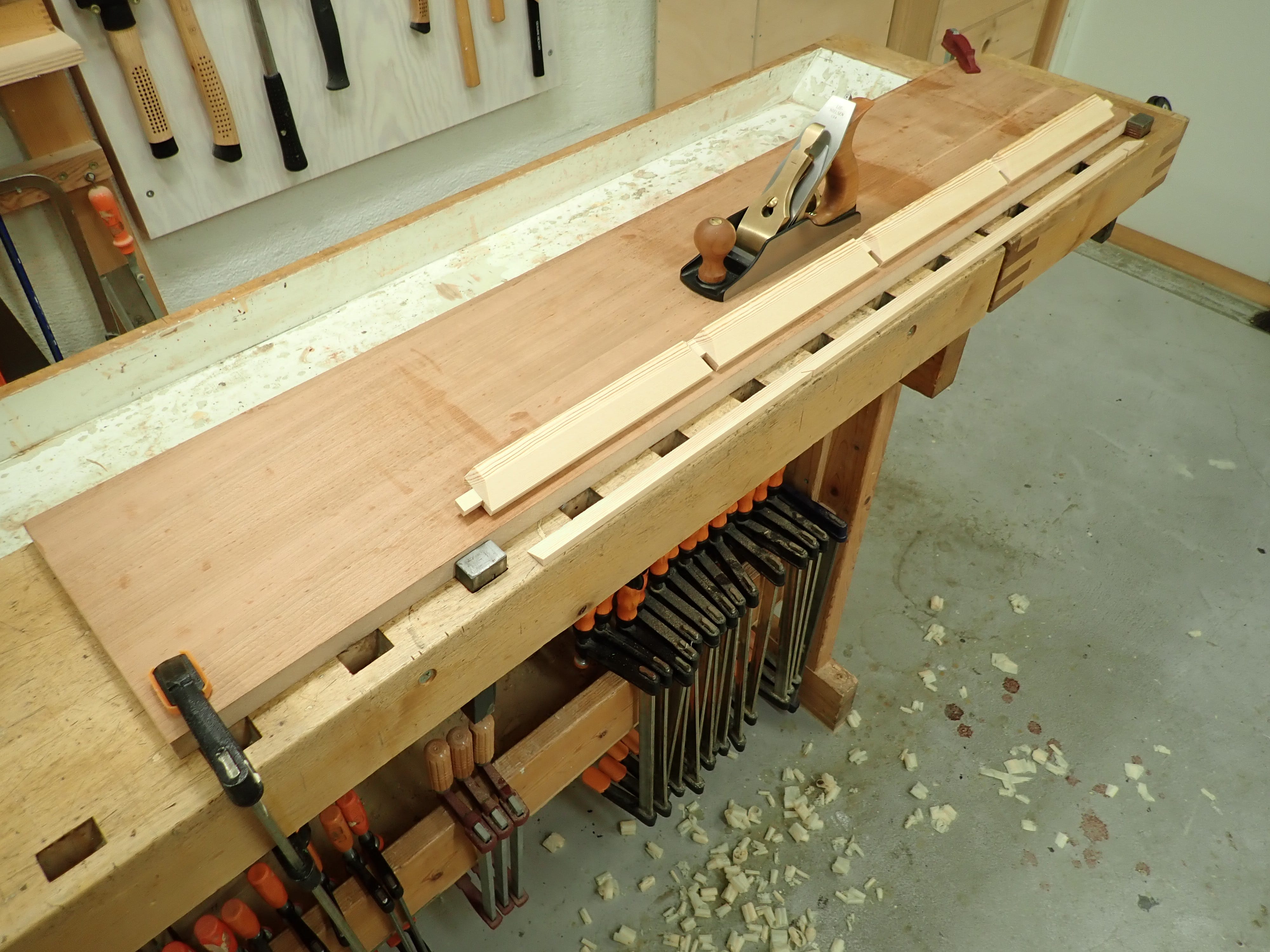
A suitably sized scrap of (in this case) veneered MDF clamped down to resist sideways deflection …
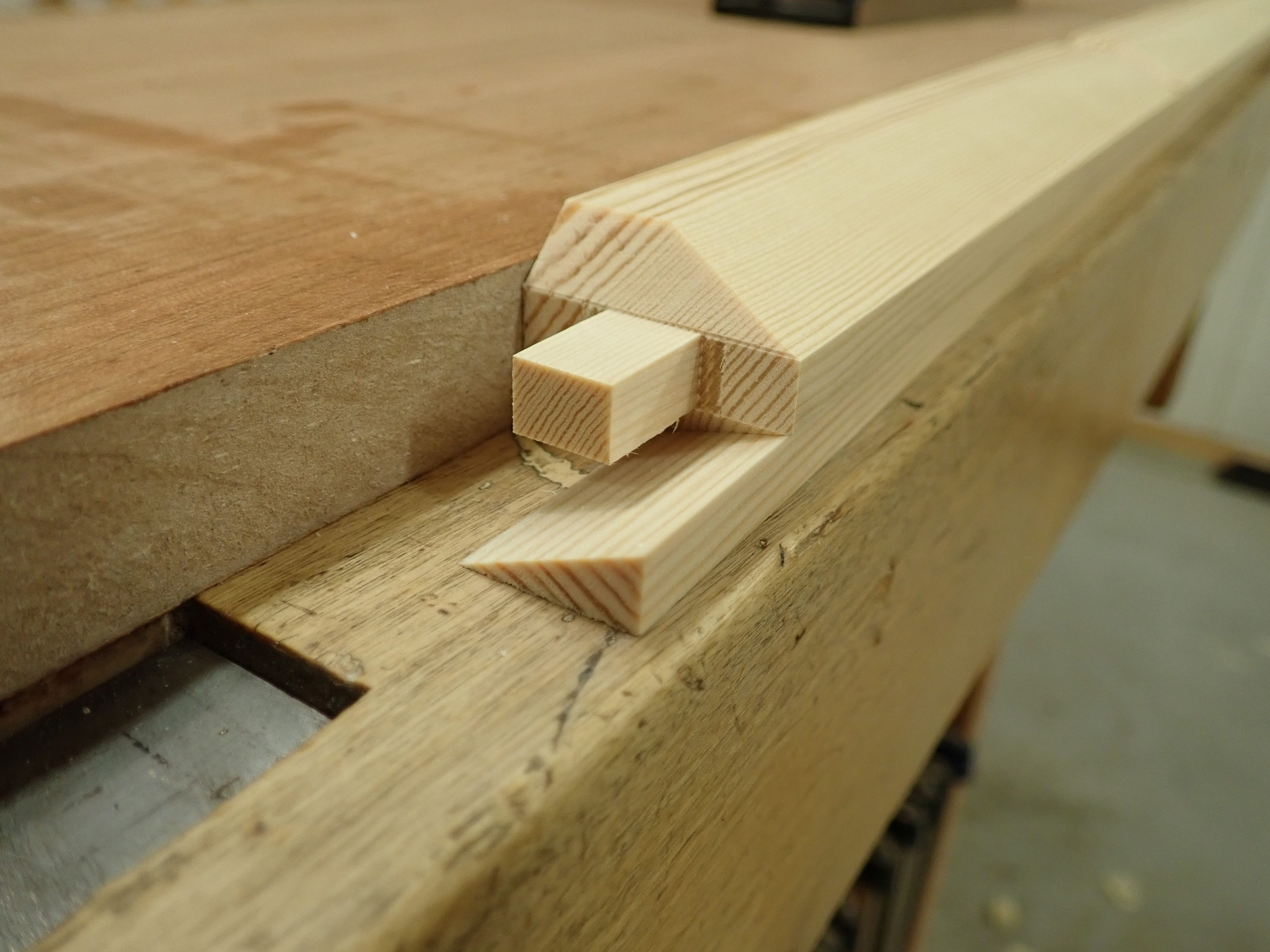
… and the angled offcut from my previous post (about cutting chamfers on the table saw) used as support. Simples!
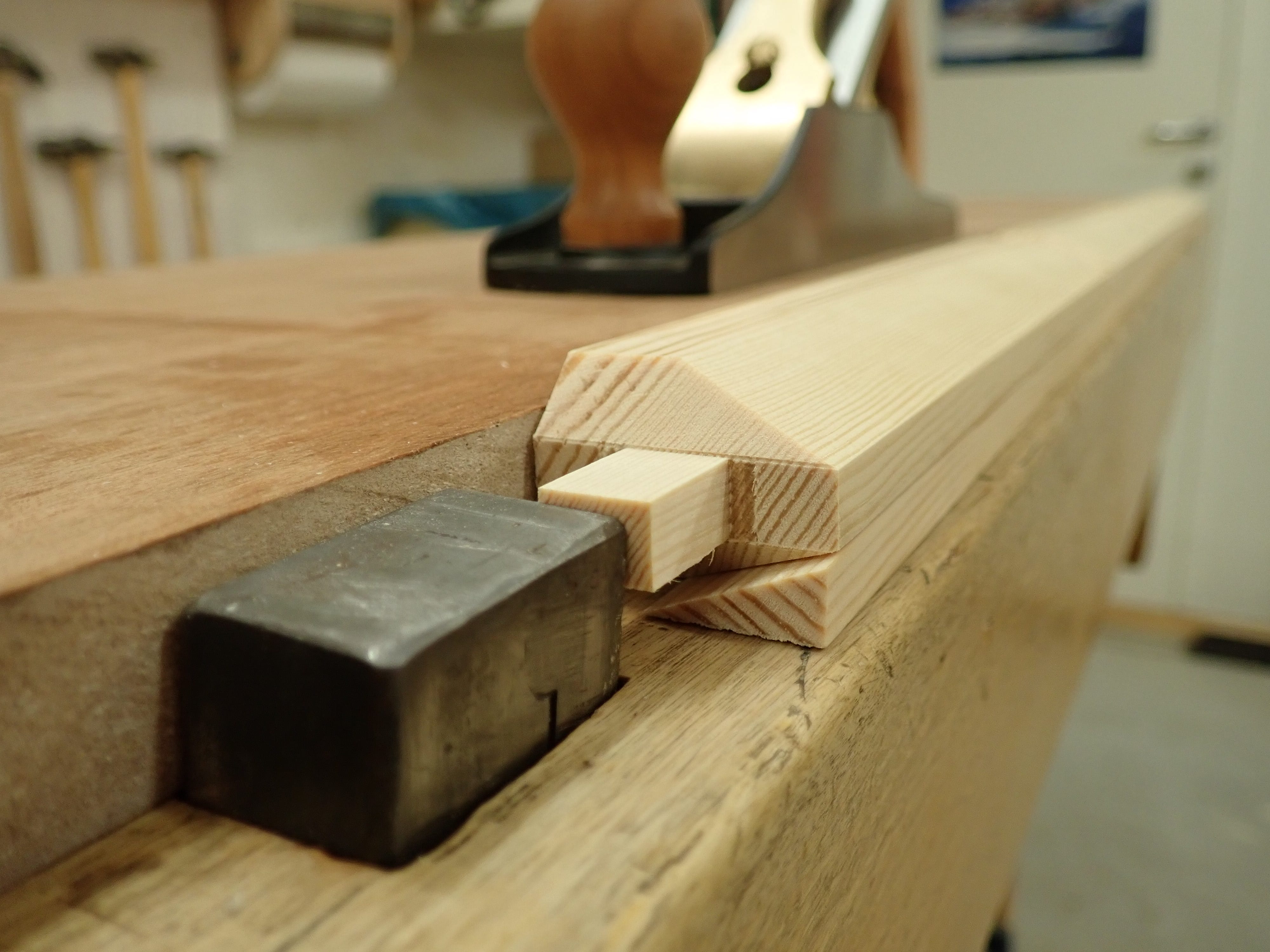
Another solution would be to make a ‘sticking board’ - a custom-made, long tray that’s shaped to cradle and hold your thin stick in place, but that entails more work than my simple kludge.
***

***
You do yourself a disservice by assuming you have nothing useful to share. I always learn something from your posts! Thank you for sharing your knowledge
Brilliant!